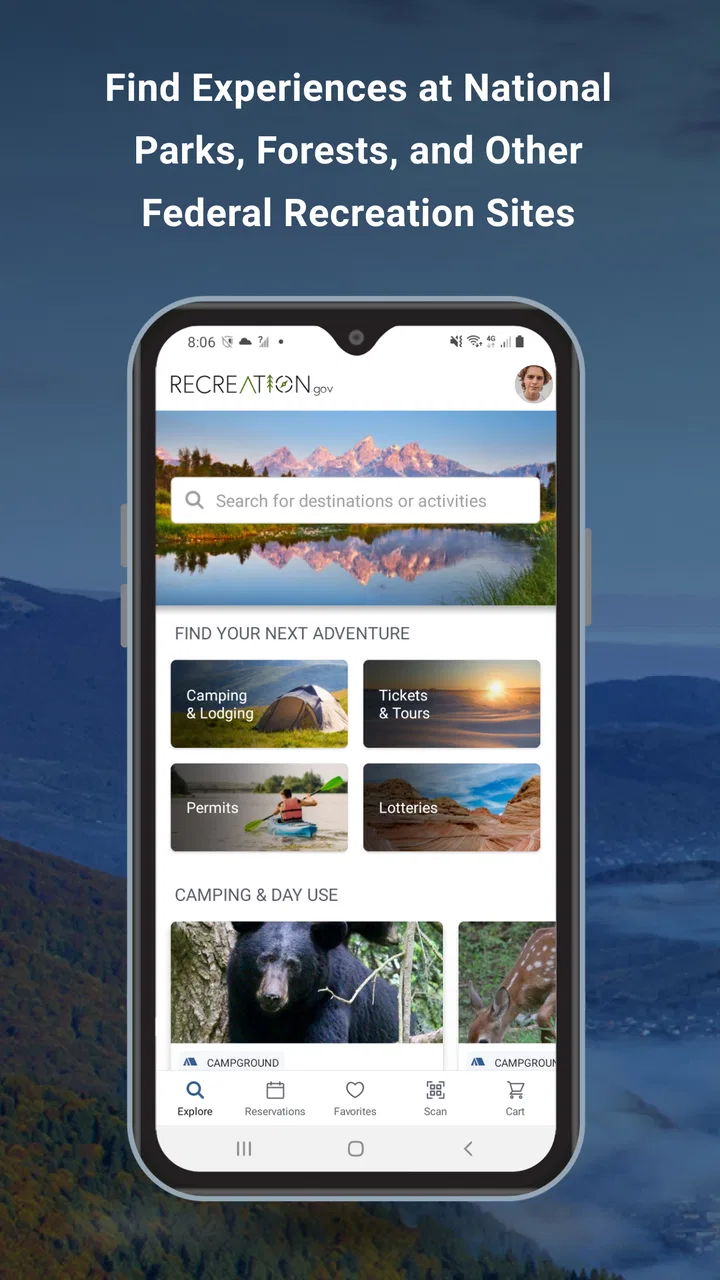
Recreation.gov
- 4.8
- Rating
- 1.00M
- Installs
- Free
- Price

 Analysis by App-foxy
Planning time outdoors sounds simple until the practical questions begin: which public lands accept reservations, whether a campsite is available, what a permit costs, and where the official booking process starts. Recreation.gov is built for that part of the trip. I found it most useful not as a source of inspiration, but as a working tool for turning a vague idea such as “I want to camp next month” into a search for a specific place, date, and reservation.
This free Travel & Local app comes from Booz Allen Hamilton, Inc. and is aimed at camping, RV travel, and outdoor recreation. It is rated for Everyone, so it is approachable for families as well as individual travelers. The app has earned a 4.8 average from around 87 thousand ratings, with more than a million installs, which matches my impression that it is a familiar tool for people who regularly visit public recreation areas.
What Recreation.gov feels like during the first week
The initial appeal is clear: instead of jumping between unrelated websites for campgrounds, permits, and recreation areas, I can begin with one recognizable place. The app’s role is practical rather than decorative. It helps me look for an outdoor destination and then move toward the reservation or permit details connected with that place.
You May Also Like

 Blood Strike: 2.5 Anniversary
Blood Strike’s Loadouts Turn Every Drop Into a Tactical Gamble
A close look at Blood Strike’s custom loadouts: how fast access to signature weapons reshapes its battle royale rhythm, rewards preparation, and narrows the gap between fights.

 Pandora - Music & Podcasts
Pandora’s Music Is Easy to Start, but Harder to Recover
Pandora’s strength is its low-effort path from a seed to a station. Its weak spot is how much confidence it asks you to place in connection, setup, and quiet recovery.

 8 Ball Pool
 Is Built on Rivalries, Rematches, and Routine
A close look at the rivalries, rematches, shared routines, and unanswered safety questions that turn a quick pool match into a persistent mobile community.

 Samsung Music
’s Quiet Strength Is Playing What You Already Own
Its reach comes less from spectacle than from dependable access to a personal library. That simplicity is both the app’s strongest retention engine and its ceiling.

 AccuWeather: Weather Radar
AccuWeather Review: A Quick, Clear Forecast for Everyday Decisions
For everyday plans, the best forecast is the one you can understand quickly. AccuWeather makes rain timing, radar, and local conditions easy to act on, with a few trade-offs.

 Hill Climb Racing
Why Hill Climb Racing Still Turns Crashes Into One More Run
A tiny car, a bumpy hill and one more upgrade: Hill Climb Racing keeps resurfacing because its simple chaos makes every near-miss feel personal.
More From Our News Desk



That distinction matters. Many travel apps are designed around hotels, restaurants, or sightseeing, while this one is focused on public outdoor use. A campsite is not simply a room with a view. It may involve a booking window, a specific site, arrival restrictions, equipment limits, or a separate permit requirement. Recreation.gov makes more sense when I already have an outdoor plan and need to check the official logistics.
During a first search, I would not treat the app as a complete trip planner. I use it to narrow down the location and understand what must be reserved. Then I verify the details that affect the whole outing: the type of site, the dates, the party size, and whether the activity requires something beyond a campsite booking. This extra reading is not wasted time. It prevents the common mistake of assuming that reserving a place to sleep automatically covers every activity in the area.
The app is especially appealing to someone arranging a weekend away from a phone full of saved map pins and browser tabs. If I am comparing several public campgrounds, having the relevant booking flow in one app is more convenient than remembering which agency manages each destination. It also gives a more direct route to availability than relying on a social post or a third-party travel page that may be outdated.
A useful early habit is to search with flexibility rather than entering one perfect plan. I would compare nearby dates and different site types before becoming attached to a single campground. Outdoor reservations can be less forgiving than hotel bookings, and a small change in timing or equipment can make a large difference. The app is more valuable when I use it as a comparison workspace instead of a final confirmation button.
A realistic weekend planning example
Imagine I want to take a small RV trip with friends. On the first evening, I can search for a suitable recreation area, inspect the available dates, and note whether the site matches the vehicle and the group. Rather than stopping after seeing an open date, I would read the location notes and reservation conditions carefully, then check the driving route and nearby services in a separate map app.
That workflow shows both the strength and the boundary of Recreation.gov. It can organize the reservation side of the trip, but it does not replace judgment about fuel, weather, road conditions, food, signal coverage, or emergency planning. I would save the confirmation details and keep an offline copy of anything essential before leaving, because outdoor travel should not depend on a live connection at the campsite.
For a family, the first-week value comes from reducing uncertainty. Parents can check whether a location suits the group before committing, while children may benefit indirectly from a smoother plan. For a solo traveler, the advantage is different: the app can make the administrative side less intimidating, particularly when a destination has formal booking or permit steps that are easy to overlook.
Where it beats the usual alternatives
The usual alternative is a general travel marketplace, a search engine, or the website of an individual park. Those options can be useful, but they often make me assemble the picture myself. A general marketplace may emphasize lodging and reviews rather than public recreation rules. A search engine may return unofficial guides before the actual reservation path. A single park website may be excellent for that park but less convenient when I am comparing several destinations.
Recreation.gov has an advantage when the destination belongs to the network of recreation opportunities it covers. It gives the planning process a consistent starting point and keeps the reservation task closer to the source responsible for the booking. That is more reassuring than making a payment through an unfamiliar intermediary.
It is not automatically better than every alternative. A dedicated park website may explain local closures, trail conditions, accessibility, or seasonal details more clearly. A mapping app remains better for route planning and navigation. For spontaneous roadside stops, I may prefer a map or campground discovery app because it can show a broader range of private and informal options. The right choice depends on whether I need official reservation handling or broad travel discovery.
What keeps its value after the first month
The lasting value appears when outdoor trips become recurring rather than occasional. After the novelty of installing a new travel app fades, I ask whether it saves effort the next time I plan a trip. In this case, the answer is yes when my travel includes reservable public recreation areas. I do not need to relearn a different booking process every time I consider another campground or permit-based activity.
That recurring value is strongest for people who camp several times a year, travel with an RV, or return to public lands for seasonal trips. The app can become part of a repeatable routine: choose a region, compare dates, inspect the site requirements, reserve what is needed, and store the confirmation with the rest of the travel documents. The routine is not exciting, but dependable tools earn their place by making necessary work easier.
I also like the way this encourages earlier planning. A casual “we will decide later” approach can fail when the preferred dates disappear. Opening the app during a monthly planning session gives me a reason to check possible destinations before the rest of the trip is arranged. Even when I do not book immediately, I can identify which locations deserve further research and which ones are poor matches for my group.
For RV travelers, the trade-off between a convenient site and a suitable site deserves particular attention. I would not judge an opening only by its date. I would compare the site’s fit with the vehicle, the people traveling, and the intended length of stay. An app can present availability, but it cannot decide whether a particular setup will be comfortable or practical for me.
Another recurring use is coordinating a group. I can use the app to establish the exact destination and reservation details, then share the important information with everyone else. This reduces the familiar problem where one person says “the campground near the lake” and another arrives at a different place. The app is not a group chat, but it can provide a common reference point for the plan.
Recreation.gov is also useful for separating research from commitment. I can investigate several areas before asking friends to choose dates. That prevents a group discussion from being based on an attractive destination that has no suitable availability. The more people involved, the more valuable this early filtering becomes.
How much maintenance it demands
The maintenance burden is moderate rather than invisible. I need to keep the app current enough to use the current version, 2.2.35, and I should review reservation information again shortly before departure. Updating an app does not guarantee that every trip detail has stayed the same, so I would still read the latest confirmation and any destination-specific instructions.
My own maintenance routine would be simple. Before booking, I check the dates, site category, party information, and any permit relationship. After booking, I save the confirmation where it can be found quickly. Before leaving, I revisit the reservation and look for changes that could affect arrival. This routine takes a few minutes, but skipping it is where many outdoor plans become stressful.
The app should not become the only record of a trip. I would keep the reservation number or confirmation information in another secure place and download maps separately if I expect weak coverage. That is not a criticism unique to this app; it is a sensible habit for any travel service used in remote areas. Still, it affects the app’s long-term convenience because preparation outside the app remains necessary.
Its free price makes keeping it installed an easy decision for people who camp regularly. There is no financial pressure to remove it after one trip, and the app can remain available for the next planning cycle. For someone who takes one outdoor trip every few years, however, the benefit is smaller. That person may still find it useful when planning, but there is less habit value afterward.
The friction that can create fatigue
The biggest source of fatigue is not the basic idea of the app; it is the complexity of outdoor reservations themselves. A user may expect a simple calendar and become frustrated when the real decision involves site suitability, permits, arrival rules, or destination-specific conditions. Recreation.gov can make the process more organized, but it cannot make public-land logistics as effortless as booking a standard hotel.
Availability can also encourage unproductive repetition. If my preferred weekend is unavailable, I may find myself checking the same search again and again. The app is useful for comparing alternatives, but it does not remove the emotional friction of adjusting plans. I get better results when I decide in advance which dates, regions, and site types are acceptable instead of refreshing one ideal option indefinitely.
Another limitation is scope. Someone looking for a broad travel guide, restaurant ideas, scenic drives, or a complete itinerary may find the app too narrow. It is not the tool I would open first for inspiration in an unfamiliar city. Its purpose is much more specific: helping me handle outdoor recreation reservations and related planning in the places it serves.
There is also a learning curve for first-time campers. A beginner may not know the difference between a campsite category, an activity reservation, and a permit. I would advise new users to read every description and avoid booking quickly just because a date appears open. If the wording is unclear, I would consult the destination’s official information before paying or finalizing plans.
That careful approach is the difference between a useful reservation tool and a source of disappointment. An open slot is not necessarily the right slot. A beautiful destination may be unsuitable for an RV, a large group, a late arrival, or someone who needs particular facilities. The app helps expose the decision, but I still have to make it responsibly.
Who should keep it installed
I would keep Recreation.gov installed if I regularly camp, travel by RV, or visit public recreation areas that use its reservation system. It is also a sensible choice for families who want one consistent place to begin researching outdoor bookings, and for travelers who prefer dealing with an established reservation channel rather than relying on scattered third-party pages.
I would be more selective if my trips are mostly spontaneous, urban, or centered on private hotels. In those cases, a general travel app may offer more useful discovery and booking options. I would also look elsewhere first if my main need is live navigation, trail recording, restaurant search, or a complete weather-and-road picture. Recreation.gov can sit beside those tools, but it does not replace them.
Its Everyone age rating makes it suitable for a broad audience, although suitability of the app is not the same as suitability of every outdoor activity. Parents still need to judge the destination, access conditions, and activity demands for their children. The app can support the booking process, but it cannot assess a family’s readiness for a particular environment.
My long-term verdict
After the first-week appeal wears off, Recreation.gov earns lasting space when it becomes part of a repeatable outdoor planning habit. I value it less for entertainment than for reducing the administrative friction between an idea and a confirmed reservation. That is a modest promise, but it is one the app can fulfill well when the destination fits its coverage and I take time to read the details.
The developer, Booz Allen Hamilton, Inc., has produced a tool that feels most worthwhile for organized outdoor travel rather than casual browsing. Its strongest quality is consistency: I know where to begin when I am looking for a public campground, RV opportunity, or reservation-related outdoor plan. Its weakness is equally clear: I still need maps, destination research, offline preparation, and common sense to complete the trip.
With its free access, an Everyone rating, and a current version of 2.2.35, it is easy to recommend keeping it available for the next camping plan. I would not tell every traveler to make it their main travel app. I would tell anyone who repeatedly books public outdoor recreation to give it a proper trial, build a careful checking routine, and judge it by whether it saves time across several trips rather than by how exciting it feels on the first day.
My recommendation is straightforward: keep it if official outdoor reservations are a regular part of your life; skip it if you mainly need broad travel inspiration or spontaneous discovery. For the right traveler, Recreation.gov is not a novelty app. It is a practical piece of trip maintenance that continues to justify itself each time a new camping or RV plan moves from wishful thinking to an actual booking.
FAQs for Recreation.gov
01What is Recreation.gov and how does it work?
Recreation.gov is a comprehensive platform that facilitates booking and managing outdoor recreational activities across the United States. Users can search for campsites, permits, and tours in national parks and forests. The app provides detailed information about each site, allowing users to plan their trips and make reservations directly through the platform.
02How do I create an account on Recreation.gov?
To create an account on Recreation.gov, simply download the app or visit the website and click on the 'Sign Up' option. You’ll need to provide basic information such as your name, email address, and create a password. Once registered, you can start browsing and booking activities immediately.
03Are there any fees associated with using Recreation.gov?
While downloading the Recreation.gov app is free, booking certain activities or sites may incur fees. These fees vary depending on the type of reservation, such as campsite bookings or permits for specific activities. Always check the details for each reservation, as some may include additional service or processing fees.
04Can I cancel or modify my reservation through the app?
Yes, Recreation.gov allows users to cancel or modify their reservations directly through the app or website. However, cancellation policies and fees vary depending on the specific reservation. It’s important to review the cancellation policy for each booking to understand any potential charges or conditions before making changes.
05Is the Recreation.gov app available for both Android and iOS devices?
Yes, the Recreation.gov app is available for both Android and iOS devices. Users can download it from the Google Play Store or the Apple App Store for free. The app is designed to provide a seamless and user-friendly experience across different devices, ensuring easy access to recreational planning tools.
Pros
- Easy-to-use interface for planning trips.
- Comprehensive listing of parks and activities.
- Real-time availability updates for bookings.
- Secure and simple payment options.
- Access to user reviews and ratings.
Cons
- Limited offline functionality for remote areas.
- Occasional app crashes reported by users.
- Some features require a stable internet.
- Not all park services are fully listed.
- No personalized recommendations feature.

Recreation.gov
Gallery